


Less than 20% of procurement teams are getting the digital technology they need, research from Gartner reveals.
Gartner’s Jeremy Suter Director of Advisory says the profession is largely “self-sabotaging” itself by refusing to make the right case for procurement technology for fear of it being knocked back.
Gartner’s research revealed 24% of the tech the procurement profession needed it doesn’t ask for.
Jeremy, who spoke at PASA’s recent ProcureTech event, said the profession was scaling back requests just to get them approved.
“We’re guaranteeing we’re not going to get exactly what we want and we might even end up getting a lesser version of the things we didn’t want in the first place. Which is really why I would consider this to be self-sabotage rather than self-censorship when it comes to your, procure procurement technology approvals,” he said.
More than 250 procurement professionals and key decision-makers were surveyed on how can procurement more consistently secure approval for desired technology solutions.
Why business cases get knocked back
The top three explanations by procurement leaders for business cases being refused included:
- Resources available but directed to another priority.
- Resources not available.
- The business case overall isn’t persuasive.
However, for decision-makers, the top three reasons were somewhat different, suggesting procurement doesn’t sell its request well enough to those with the tech purse strings.
- Insufficient value proposition to justify resources requested
- Business case overall isn’t persuasive
- Resources not available
“They (decision makers) told us that when they rejected these business cases or not fully funded them, it’s because we didn’t make a compelling enough case or demonstrate enough value proposition for the resources we’re asking for,” Jeremy said.

The Gartner research revealed business cases presented by procurement were falling short of the mark. A total of 57% of business cases did not fully explain the problem the technology would help to solve.
“If we’re going to convince somebody that we need to solve a problem, we’re going to need to convince them that there’s a problem in the first place, right?” Jeremy said.
“And yet, 57% of the time we’re not even clearing that.”
Three ways to make your business case more persuasive
- Improve the data – use strong facts and figures
- Craft a more compelling narrative – clearer explanation of data can lead to 1.6 great approval rates.
- Build and leverage a coalition of support – building buy-in can increase approval rates by two times.
“We can almost pre-wire the business case. Get other functions or stakeholders on board with what we request, and importantly, before we request it. And again, this is to help tackle a common, decision maker concern surfaced by the surveys that we did, that we don’t always effectively get buy-in for our business cases before we submit them,” Jeremy said.
How framing can help with business cases through
Jeremy urged procurement to consider the use of framing as a means to give business cases a better chance at the approval stage.
“Framing leads an audience to interpret an argument in a specific way by deliberately choosing phrasing and words to express a fact or figure in a way that resonates or aligns with the audience’s pre-existing beliefs and priorities without changing the fact or figure,” Jeremy explains.
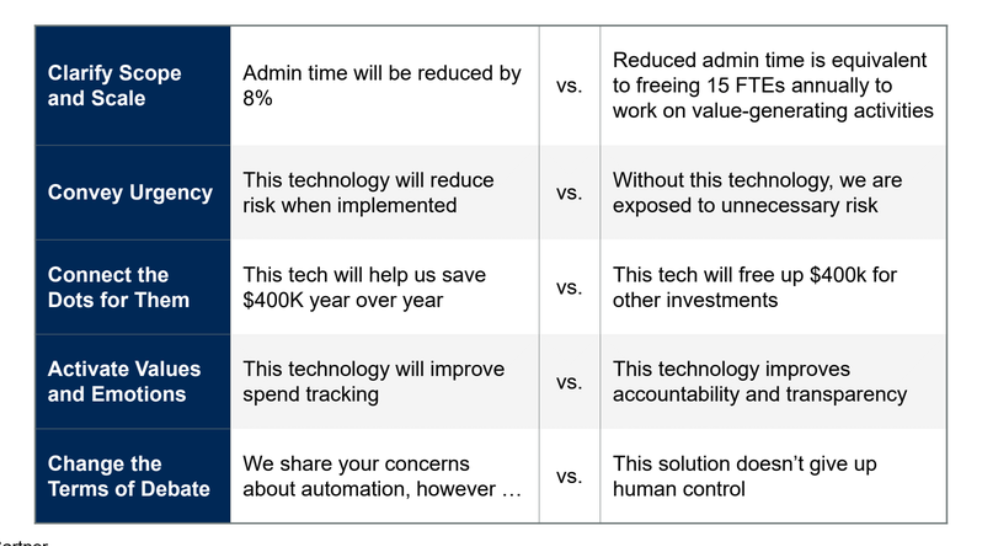
When it comes to communicating the request, Jeremy said having a clear plan in place can help the business case get a better chance of being approved.
Communications tactics that can pay off include:
- Develop clear communication plans for how you will
build and pitch the business case
- Emphasize alignment between your request and other functions’ priorities
- Identify in advance which facts and figures need to be emphasized to each stakeholder
- Identify different ways facts and figures can be framed to make them most persuasive
In closing, Jeremy says procurement technology has always been hard to get and predicted this would get harder.
He said procurement business cases that were clearer and more persuasive were more successful and need to “ask for exactly what you want.”
Building advocates is something else he championed and encouraged the development of “a coalition of supporters” to support the business case.
